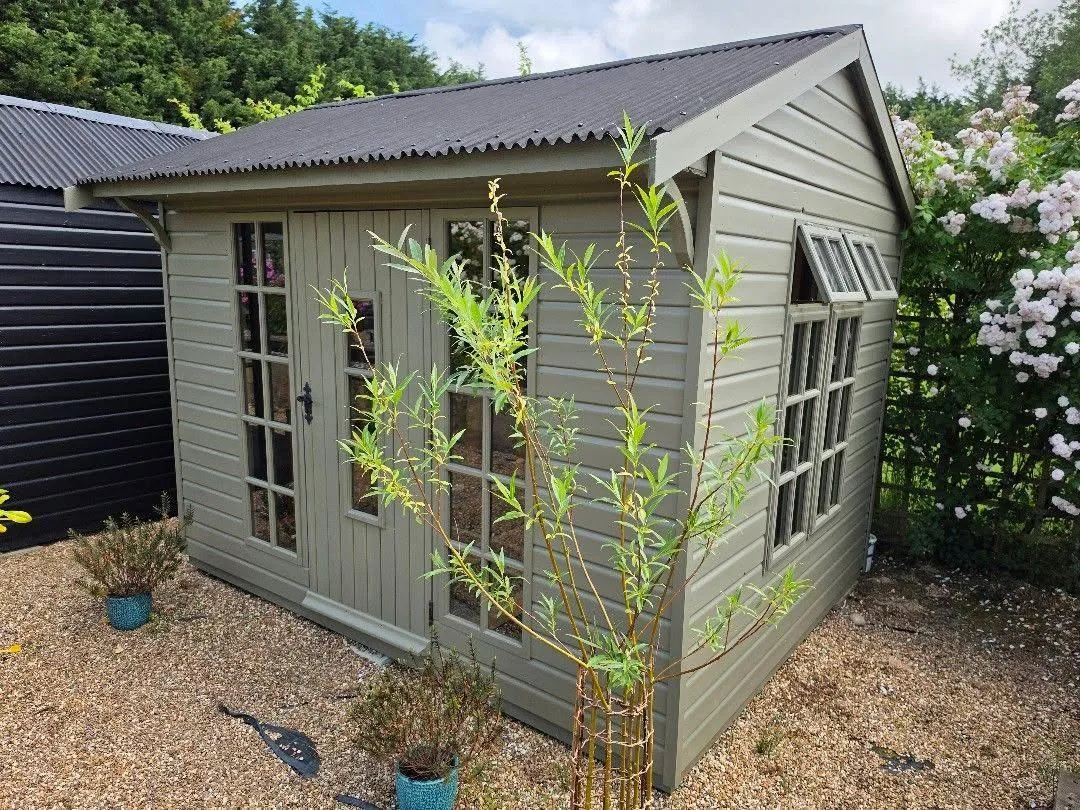
It's the first question almost everyone asks when they start thinking about a garden room, garden studio or shepherd-style building: will I need planning permission? The honest answer is that very often you won't, but there are some important limits, and a few situations where the rules are tighter.
This is a plain-English guide to how it usually works for homes in Kent and East Sussex. Rules vary by property and by council, so treat this as a starting point and always check your own situation before you order.
When a garden room usually doesn't need planning permission
Most houses have what are called "permitted development rights", which allow outbuildings in the garden without a planning application, provided the building stays within a set of limits. In general, a garden room is likely to be fine if:
- It is a single-storey building, with eaves no higher than 2.5 metres.
- The overall height is no more than 4 metres with a dual-pitched (apex) roof, or 3 metres for any other roof type, such as a pent or flat roof.
- If any part of it is within 2 metres of a boundary, the overall height is no more than 2.5 metres.
- It isn't in front of the main wall of the house that faces the road.
- Together with any other outbuildings, it covers no more than half of the garden around the original house.
- It has no veranda, balcony or raised platform higher than 30cm.
- It is used for purposes incidental to the house, such as a home office, studio, gym, hobby room or summerhouse, rather than as a separate home.
On that last point, using a garden office to work from home is often fine, but if you'd be running a business from it, for example with clients or staff visiting, check with your council first.
When you should check first
Permitted development rights don't apply everywhere. It's worth speaking to your local council's planning team before you order if:
- Your home is a listed building, or the building would sit within its grounds.
- You live in a conservation area or a designated landscape. Parts of Kent and East Sussex fall within the Kent Downs and High Weald National Landscapes (formerly Areas of Outstanding Natural Beauty), where the limits on outbuildings are tighter.
- Your property is a flat or maisonette, which doesn't have the same outbuilding rights as a house.
- Your house is a more recent new-build, where permitted development rights are sometimes removed by a planning condition, or your council has issued what's known as an Article 4 direction.
- You'd like the building to be bigger or taller than the limits above, or you plan to use it as somewhere to live or sleep regularly.
Building regulations are a separate question
Planning permission and building regulations are two different things, and it's easy to mix them up. Many garden rooms fall outside building regulations, but not all:
- Outbuildings under 15 square metres with no sleeping accommodation are generally exempt.
- Between 15 and 30 square metres, they're generally exempt if there's no sleeping accommodation and the building is at least 1 metre from the boundary (or is built largely of non-combustible materials).
- Larger buildings, or anything used for sleeping, will normally need building regulations approval.
- Any new electrical supply to a garden room needs to be installed and certified by a registered electrician, whatever the size.
Peace of mind: a Lawful Development Certificate
If you'd like certainty, you can apply to your council for a Lawful Development Certificate. It's an official confirmation that your proposed building doesn't need planning permission, and it can be useful later if you come to sell the house.
How we can help
Every garden building we make is designed around your garden, so we're used to working within height and boundary limits, whether that means a lower roofline near a fence or a size that suits a tricky plot. If you'd like to talk through what would work on your property, give us a call on 01797 253816 or get in touch. You can also see what we build for garden rooms and garden studios across Kent.
This guide is for general information only and isn't legal advice. Planning rules change and vary by property, so always confirm the position with your local planning authority.